
Drainage Swale vs French Drain: Which One Fits a North Carolina Yard?
A drainage swale fits water that runs across the top of the ground. A French drain fits water that soaks into the soil and stays there. Many North Carolina yards need both, and the fix often starts with a regrade.
Ask one question first: is the water on the surface or in the ground? Sheet flow across the lawn and runoff off a driveway are surface water. A lawn that stays soggy and water against a footing are subsurface water.
Cornerstone Excavation Group builds both as part of our yard and lot drainage work. We are based in Indian Trail, on the east side of Charlotte.
What is a drainage swale?
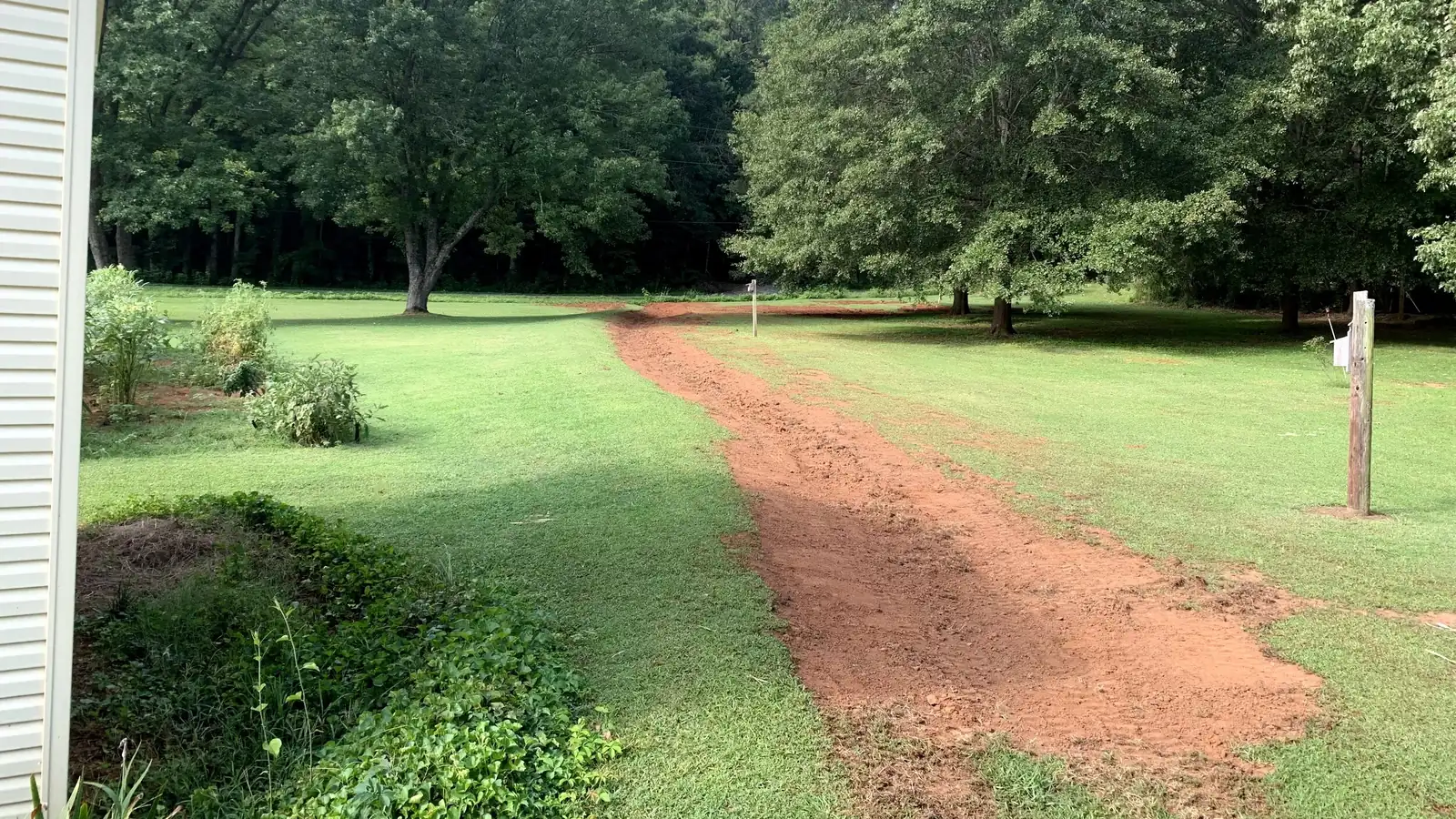
A drainage swale is a shallow, wide channel shaped into the ground so water has a path to follow. A grass swale is the common yard version, lined with turf.
The grass does real work. The U.S. Environmental Protection Agency (EPA) says the vegetation slows stormwater down as it flows along the channel. The EPA adds that grassed channels, dry swales, bioswales and wet swales all improve on the traditional drainage ditch.
Swale drainage suits water you can see moving. A yard swale along a property line can catch runoff from the next lot and steer it around the house.
What is a French drain?
A French drain is a sloped trench with a perforated pipe, surrounded by gravel or stone. Water seeps into the stone and runs through the pipe to an outlet. Filter fabric around the stone keeps clay and silt out of the pipe.
A French drain works below the surface. It suits a lawn that stays soggy and water that sits against a footing. It also fits a wet strip where grading alone will not work, such as a tight side yard.
Every French drain needs fall and a place to empty. With no lower outlet, the pipe fills up and holds the water where it is.
Swale vs French drain: which one fits your yard problem?
Match the fix to where the water sits.
| Yard problem | Usual fit | Why |
|---|---|---|
| Sheet flow across the lawn after rain | Drainage swale | The water is on the surface |
| Runoff from a driveway or the next lot | Drainage swale | A swale catches it and steers it around |
| A low spot that ponds | Regrade first, then a swale | The water needs a way out |
| A lawn that stays soggy for days | French drain | The water is in the soil |
| Water against a footing | French drain | The pipe collects it below grade |
| A wet strip too tight or flat to regrade | French drain | The surface cannot change |
| Water standing in an existing swale | Both | A drain goes under the swale |
Many yards need both. One national cost guide notes that some homeowners use the two systems in tandem. A landscape design publication says a French drain can go beneath a swale’s flow line where water stands. That lets the surface soil dry out.
Grade comes first in a lot of yards. If the ground falls toward the house, regrading the yard is the real fix. A swale or a drain then finishes the job. One of our jobs shows the pairing: a graded swale that carries water to a precast outlet box.
Why does North Carolina red clay change the choice?
Piedmont red clay drains slowly. NC State Extension says much of the subsoil in the Piedmont has high clay content. It says soils with high clay content tend to have slow water movement and may stay wet for long periods. Construction compacts the soil, which slows water movement even more.
That matters on new-construction lots around Charlotte and Union County. In tight clay, a French drain needs a real outlet, because the clay around the trench soaks up little. A swale in clay should keep the water moving to its outlet.
The EPA says most soils suit grassed swales, with some limits on the most impermeable soils (hydrologic soil group D).
How do you build a drainage swale that lasts?
North Carolina’s treatment swale rule is 15A NCAC 02H .1061, which took effect January 1, 2017. It does not cover a vegetated channel built only to carry water. So a yard swale is not held to it, but the rule makes a good benchmark:
- Side slopes no steeper than 3:1. The EPA says swales often have side slopes flatter than 3:1.
- A trapezoid shape with a bottom no wider than 6 feet.
- A lengthwise slope of 7 percent at most. The EPA says design documents generally recommend 1 to 2 percent.
- On steeper slopes, the EPA says the water moves fast enough to erode the channel.
- A bottom that never sits below the seasonal high water table. The EPA says designers keep it at least 2 feet above the groundwater table.
- Deep-rooted grass that can take a flow of 4 feet per second, kept at about 6 inches.
- Room to pass the 10-year storm without eroding.
On a yard job, we contact NC811 first. State law calls for notice at least three full working days before digging. Then we cut the channel to a steady fall and shape the sides. The low end gets a stable outlet where the water can leave without washing out the soil.
Bare dirt washes out in the first hard rain. So the channel gets seed with mulch or matting until the grass takes hold. On a site that needs it, we put in erosion control while the ground is open.
A treatment swale on a permitted site is a different job. An engineer designs it under the site’s stormwater permit, and we build to that plan.
What does a drainage swale cost compared to a French drain?
These are market numbers, not our price list. They come from one national cost guide, updated July 9, 2026, plus an undated landscape design publication.
| Drainage method | Published market range | Kind of source |
|---|---|---|
| Drainage swale, by area | $0.50 to $1 per square foot | national cost guide |
| Drainage swale, by length | $5 to $15 per linear foot | same national cost guide |
| Surface swale, by area | about $0.50 per square foot | landscape design publication, undated |
| French drain, by length | $10 to $100 per linear foot | same national cost guide |
Drainage swale cost moves with the length of the run and how much dirt has to move. A yard that needs a regrade first costs more. French drain prices swing wider, since every foot of trench needs pipe and stone. Our French drain cost guide breaks those numbers down.
Who pays to fix yard drainage in Mecklenburg County?
Mecklenburg County Storm Water Services works with the Towns of Cornelius, Matthews, Mint Hill and Pineville. It repairs drainage only when the system carries stormwater from a public street and serves the public good. Yard flooding and sheet flow from adjacent properties are on its list of non-eligible issues.
So in those towns, a yard swale or a French drain is the property owner’s to fix. Inside Charlotte or in Union County, check with your city or county.
How does Cornerstone pick between a swale and a French drain?
We look at the job on site first. We find where the water comes from and where it can go. Then we pick the swale, the drain or both, and the estimate is free.
Cornerstone is 5.0-rated on Google. We work the Charlotte metro, Union County and the York County side of South Carolina. Call or text (980) 315-5707, or see our drainage services page.