
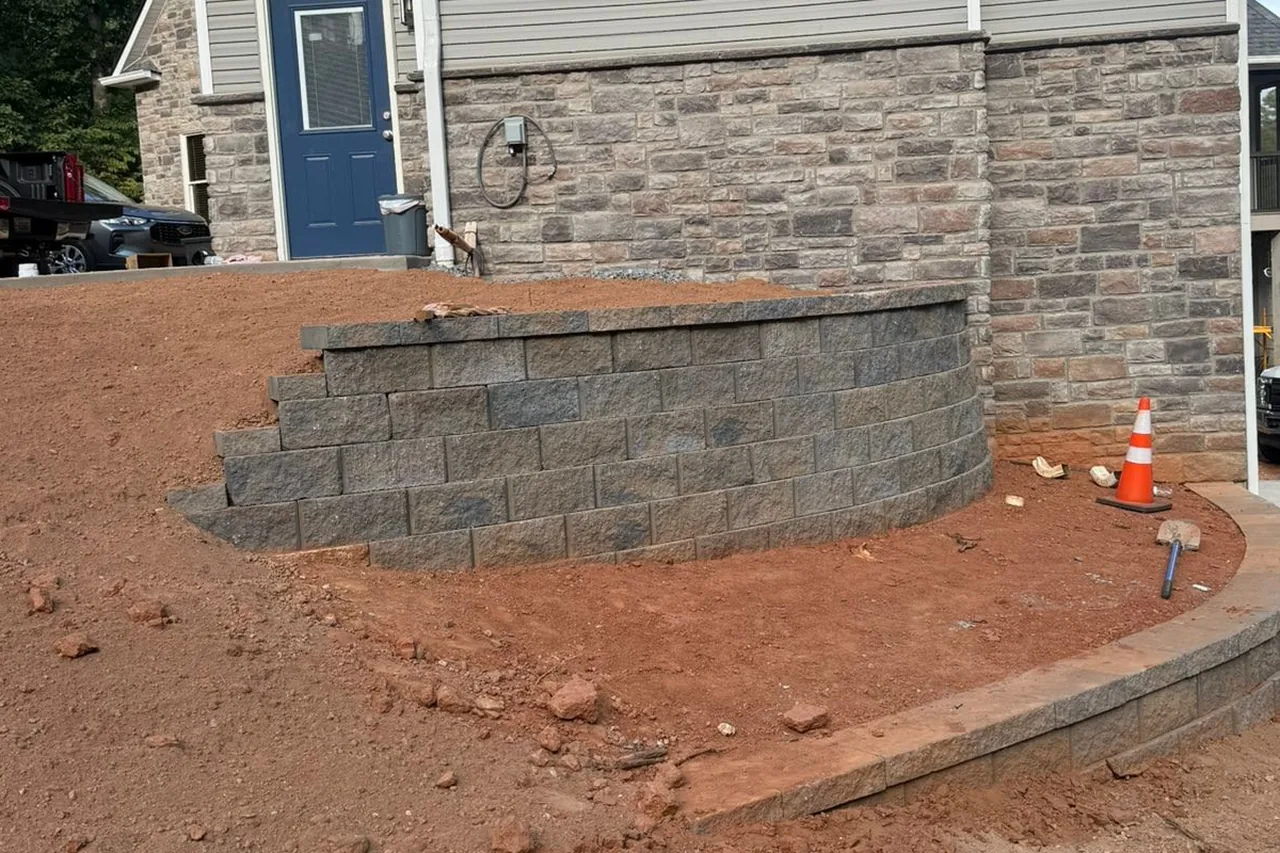
How Much Does a Retaining Wall Cost in North Carolina?
Most retaining walls in North Carolina land between about $3,200 and $9,600. National cost guides put the average near $6,000 to $6,300. A North Carolina cost report prices the work at roughly $32 to $44 per square foot of wall face.
Size is what moves that number. A short garden wall can come in under $2,000. A tall wall with an engineered design can pass $12,000. These are published market ranges, not our price list.
What Does a Retaining Wall Cost per Square Foot?
Walls are priced by face square foot. That is the height times the length of the wall you can see. A wall 3 feet tall and 30 feet long is 90 face square feet. Measure the buried course too, because a contractor still has to build it.
National cost guides put most walls at $20 to $53 per square foot, with an average near $33. One national estimating tool lists a 2026 starting point of $35.41 per square foot. The North Carolina figure of $32 to $44 sits right in that band.
Material sets the low end and the high end. Here is what national cost guides list per face square foot.
| Wall material | Installed cost per face square foot |
|---|---|
| Gabion basket | $13 to $39 |
| Standard block | $14 to $39 |
| Timber | $15 to $30 |
| Segmental block | $17 to $53 |
| Poured concrete | $24 to $58 |
| Boulder | $24 to $66 |
| Natural stone | $5 to $100 |
Natural stone shows the widest spread because the stone itself varies so much. Cornerstone Excavation Group builds segmental block walls. The other rows are here so you can read a quote. If your job calls for poured concrete or stone, a different trade handles that build. Here is how we approach block retaining walls on a slope.
What Does a Wall Cost by Height?
Height changes the wall, not only the price. Taller walls need a deeper base, a wider footprint and reinforcement layers. The table below runs the math at the $20 to $53 per square foot range from national guides.
| Wall size | Face square feet | Typical installed range |
|---|---|---|
| 3 feet tall, 25 feet long | 75 | $1,500 to $4,000 |
| 4 feet tall, 40 feet long | 160 | $3,200 to $8,500 |
| 6 feet tall, 40 feet long | 240 | $4,800 to $12,700 |
Per-foot pricing tells the same story. One 2026 installed-cost guide lists a 3 foot block wall at $110 to $165 per linear foot. The same guide puts a 4 foot wall at $150 to $220 per linear foot. A 6 foot engineered wall jumps to $400 to $700 per linear foot.
A 6 foot wall is not a taller version of a 3 foot wall. It is a different structure with a different design behind it.
What Makes a Retaining Wall Cost More?
Height is the biggest lever. Past a set height the wall needs an engineered design. That adds a design fee, a bigger base and heavier materials.
Drainage behind the wall is next. Gravel backfill, filter fabric, a perforated pipe and an outlet all sit behind the block. That buried layer is the main reason a wall holds. Water problems out in the yard often get priced with the wall, so ask how the quote handles drainage work.
Access matters too. A backyard a machine cannot reach means smaller equipment and more hours. Material has to come in and spoil has to go out the same way. A gate a mini excavator fits through saves real money.
An old wall on the site adds a line of its own. Tearing out failed block or rotted timber takes time. Then the debris has to be loaded and hauled off before the new base goes in.
Site conditions round it out. Cutting into a steep bank means more excavation and more spoil to haul. It often pulls in slope and grading work as well. If you are pricing that piece on its own, see land grading costs.
Does the Ground East of Charlotte Change the Price?
Yes. The Piedmont around Charlotte is red clay. Clay holds water and pushes hard on a wall through a wet winter. That is why the drain line and stone backfill behind the block matter here.
The Carolina Slate Belt runs through Union County east of Charlotte. Shallow rock turns up in some digs. Rock slows the base excavation and can change the plan. No contractor can price that before seeing the ground.
Do You Need a Permit or an Engineer in North Carolina?
Often, yes, once the wall gets tall. Section R404.4 of the North Carolina Residential Code is the rule. It says that retaining walls meeting its list “shall be designed by a registered design professional.” That list includes walls crossing a property line and walls supporting a building. It also covers an individual wall holding back more than 5 feet of unbalanced backfill.
The state moved that individual-wall trigger from 4 feet to 5 feet, effective January 1, 2025. Plenty of national cost guides still print the older 4 foot rule of thumb. That is one reason quotes read differently.
Counties and cities can add rules on top of the state code. Mecklenburg County, for one, publishes its own retaining wall design and construction requirements. Ask the building office over your lot what your wall needs before you sign a quote.
Permit fees are small next to the wall. National guides list $40 to $450 depending on the area. Rules differ by county and city. The owner or the builder holds the permit.
Labor or Materials: Where Does the Money Go?
Labor is usually the larger half. National cost guides put wall labor at $15 to $40 per square foot, or $50 to $75 per hour. Block, base stone, geogrid, drain pipe and caps make up the rest.
By the running foot, national guides show a $40 to $345 spread. That spread is height, access and ground conditions rather than markup. Two quotes that look far apart are often two different walls.
A useful quote breaks out the base depth, the stone, the geogrid layers and the drain line. Those items decide how long the wall stands. Ask any bidder to put them in writing.
Getting a Real Number for Your Wall
Published ranges get you close. The wall in your yard comes down to height, length, soil, access and where the water goes.
We look at the site first, then quote, and estimates are free. Call (980) 315-5707 or read more about segmental block walls around Charlotte.